
Zakat on Gold: Nisab, Rate and Calculation
Scholar Verified
Written by: M. Hamza
Researcher: Ayesha Rahman
Reviewed by: Omar Abdullah
Last Review: 9 September 2026
Our Ramadan information is carefully examined by a qualified Islamic reviewer to help ensure that religious details, references, and guidance are presented accurately and responsibly.
Zakat is due on gold when its value reaches the nisab threshold and it has remained in your ownership for one complete Islamic lunar year.
The gold nisab is generally calculated as 87.48 grams of pure gold, equal to approximately 7.5 tola or 20 dinars. The standard Zakat rate is 2.5%, or one-fortieth, of the zakatable gold's current value.
Rules about gold jewellery used for personal decoration differ between Islamic schools. If you are unsure, ask a qualified scholar who understands the method you follow.
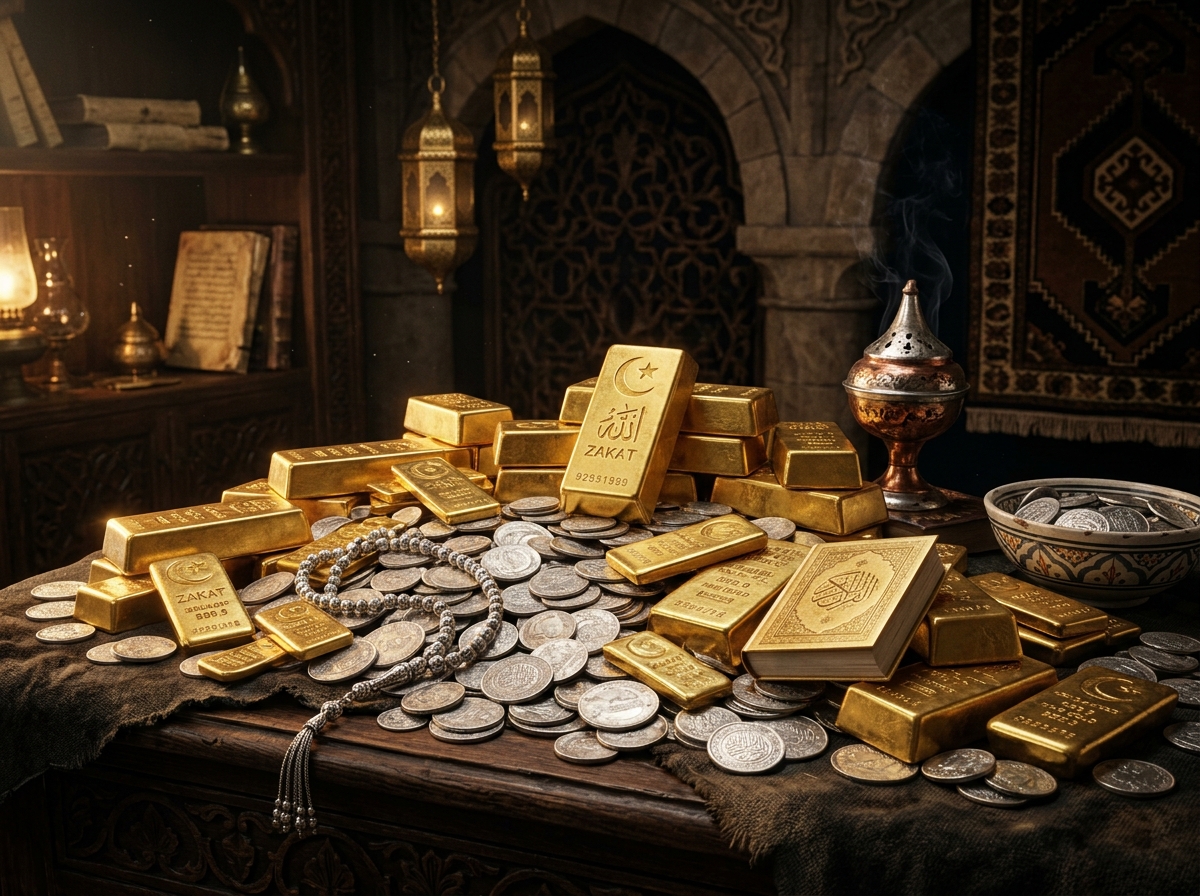
What Is the Nisab for Gold?
The nisab is the minimum amount of wealth a person must own before Zakat becomes due.
For gold, the commonly used nisab is:
- 87.48 grams of pure gold.
- Approximately 7.5 tola.
- Approximately 2.81 troy ounces.
- The value of 20 gold dinars.
"There is no Zakat on gold until it reaches twenty dinars. When you possess twenty dinars and a year passes over them, half a dinar is due."
— Reference: Sunan Abi Dawud 1573
The value of the nisab changes when the market price of gold changes. Use the current value on the date you calculate your Zakat.
How Much Zakat Is Due on Gold?
The Zakat rate on gold is: 2.5% of the total zakatable value
You can calculate it using this formula:
For example, if your gold is currently worth 1,000,000 in your local currency:
1,000,000 × 2.5% = 25,000
The Zakat due would be 25,000 in that currency.
This is only an example. Replace the amount with the current market value of your own gold.
How to Calculate Zakat on Gold
1. Weigh the gold
Find the total weight of your gold jewellery, coins, bars or other gold items.
When calculating zakat on gold jewellery, zakat is due on the actual weight of the gold, not on the value of the work done to it.
For example, if you have a 100-gram gold necklace purchased for $15,000 after having work done to it, zakat is calculated on the weight (100 grams) of the necklace, not on the $15,000 value. If the current market value of 1 gram of gold is $48, zakat will be 2.5% of $4,800 — not 2.5% of $15,000.
2. Check the purity
Gold jewellery may be 24K, 22K, 21K or 18K. Pure gold is 24K.
A simple formula for pure-gold content is:
For example, 100 grams of 22K gold contains approximately:
100 × 22 ÷ 24 = 91.67 grams of pure gold
3. Check the nisab
Compare the amount of pure gold with the nisab of 87.48 grams. You should also consider other zakatable assets, such as cash and savings, according to the method you follow.
4. Find the current value
Multiply the gold weight or pure-gold content by the current market price. Ask a trusted jeweller for the current buying or resale rate.
Do not automatically use the original purchase price. Gold prices may have increased or decreased since you bought the jewellery.
5. Pay 2.5%
Multiply the total zakatable value by 2.5%.
Is Zakat Due on Gold Jewellery?
This is one of the areas where scholars differ.
Hanafi opinion
According to the Hanafi school, Zakat is generally due on gold and silver jewellery if it reaches the nisab and one lunar year has passed, even if the jewellery is worn regularly for personal use.
Majority opinion
The Maliki, Shafi'i and Hanbali schools generally do not require Zakat on jewellery that is reasonably used for personal decoration. However, Zakat may be due if the jewellery:
- It is kept as an investment.
- Is stored rather than used.
- Is purchased for resale.
- Is excessive or beyond normal personal use.
- It is kept as a form of wealth.
Because of this difference, Muslims should follow a trusted scholar or the recognised opinion of their school.
Zakat on Gold Bars and Coins
Zakat is generally due on gold bars, coins and investment gold when:
- The total reaches the nisab.
- The owner has possessed it for one complete lunar year.
- The gold remains part of the owner's zakatable wealth.
Calculate the value using the current market rate on your Zakat date.
Gold coins should be valued according to their gold content and current worth. A collector's price may differ from the value of the gold itself, so ask a reliable dealer if necessary.
Zakat on Mixed Jewellery
Some jewellery contains gemstones, pearls or other materials. Zakat is normally calculated on the gold or silver portion, not the value of ordinary stones.
Ask a jeweller to provide:
- Total weight.
- Gold purity.
- Net gold weight.
- Current resale value.
Making charges and retail mark-ups may not reflect the actual value you would receive if the jewellery were sold. A reliable current valuation is better than simply using the original receipt.
Does the Lunar Year Start from the Purchase Date?
The one-year period is known as hawl. It is based on the Islamic lunar year, which is approximately 354 days.
If your gold reaches the nisab on a particular Islamic date, calculate its Zakat when one lunar year has passed. Many people choose one annual Zakat date, such as the first day of Ramadan, and calculate all their zakatable wealth on that date.
If the gold falls below the nisab during the year, the ruling may depend on the school of thought and the type of wealth involved. Ask a qualified scholar if your holdings change regularly.
Example Calculation
Suppose you own:
- 100 grams of 22K gold jewellery.
- Current gold value: 10,000 per gram of pure gold.
First calculate the pure-gold content:
100 × 22 ÷ 24 = 91.67 grams of pure gold
The gold is above the commonly used nisab of 87.48 grams.
Now calculate the value:
91.67 × 10,000 = 916,700
Calculate 2.5%:
916,700 × 2.5% = 22,917.50
The estimated Zakat would be 22,917.50 in the same currency, subject to the valuation method and scholarly ruling you follow.
Can Zakat Be Paid in Money?
In many cases, Zakat on gold is calculated according to its value and paid in money. This is often more practical for both the person paying Zakat and the eligible recipient.
The important point is to calculate the correct value on your Zakat date and give it to an eligible recipient through a trustworthy channel.
Who Can Receive Zakat?
Zakat should be given to people who qualify under Islamic rules, such as:
- Poor people.
- Needy people.
- People struggling with eligible debts.
- Travellers who are stranded and in need.
- Other categories recognised in Islamic law.
Do not give Zakat to a charity without checking that it distributes funds to eligible recipients. Zakat should not normally be used for general projects unless the organisation has a qualified system for handling Zakat funds.
Common Mistakes
Mistake 1: Thinking jewellery is exempt. This depends on your school of thought. In the Hanafi school, all gold jewellery is subject to zakat. Check what applies to you.
Mistake 2: Forgetting to include all gold. Some people only count their gold bars and forget jewellery or coins. All forms of gold count.
Mistake 3: Using an old gold price. The market value of gold changes daily. Always check the current price on your zakat date.
Mistake 4: Deducting the value of craftsmanship. Zakat is on the weight of gold, not the workmanship.
Final Advice
To calculate Zakat on gold, determine the gold's purity and current value, check whether your zakatable wealth reaches the nisab and pay 2.5% after one complete lunar year.
The ruling on personal-use jewellery differs among Islamic schools. For a correct calculation, especially where you own jewellery, cash, savings or debt, consult a qualified scholar and use a reliable gold valuation.
Frequently Asked Questions
Q: How many grams of gold require Zakat?
A: The commonly used gold nisab is 87.48 grams of pure gold, approximately 7.5 tola. Other zakatable wealth may also affect your calculation.
Q: What is the Zakat rate on gold?
A: The standard Zakat rate is 2.5% of the current value of the zakatable gold.
Q: Do I pay zakat on gold I wear every day?
A: In the Hanafi school, yes — zakat is due on all gold jewellery regardless of use. In other schools, no — as long as it is for personal adornment and not excessive. Follow the view of your school or local religious authority.
Q: Is Zakat due on 18K gold?
A: If it is included under your school's ruling, calculate the actual pure-gold content. Eighteen-karat gold contains 18 parts gold out of 24.
Q: Should I use the buying price or selling price?
A: Use a fair current market or resale value. A trusted jeweller can help you find an accurate rate.
Q: Is Zakat due on gold below the nisab?
A: Gold below the nisab alone does not normally reach the gold threshold. However, cash, silver and other zakatable assets may need to be considered together according to the ruling you follow.
Q: Can I pay Zakat on gold during Ramadan?
A: Yes. Many Muslims calculate and pay Zakat during Ramadan, but Zakat becomes due when the nisab has been owned for one lunar year. It does not have to be paid only in Ramadan.
Ramadan Calendar 360 — Your complete guide to Ramadan, Eid, and Islamic worship. Visit us at Ramadan Calendar 360 for prayer times, Ramadan calendars, and more.