I'tikaf in Islam: Complete Guide, Rules, Benefits, What to Do & Best Way to Spend It
Scholar Verified
Written by: M. Hamza
Researcher: Ayesha Rahman
Reviewed by: Omar Abdullah
Last Review: 9 September 2026
Our Ramadan information is carefully examined by a qualified Islamic reviewer to help ensure that religious details, references, and guidance are presented accurately and responsibly.
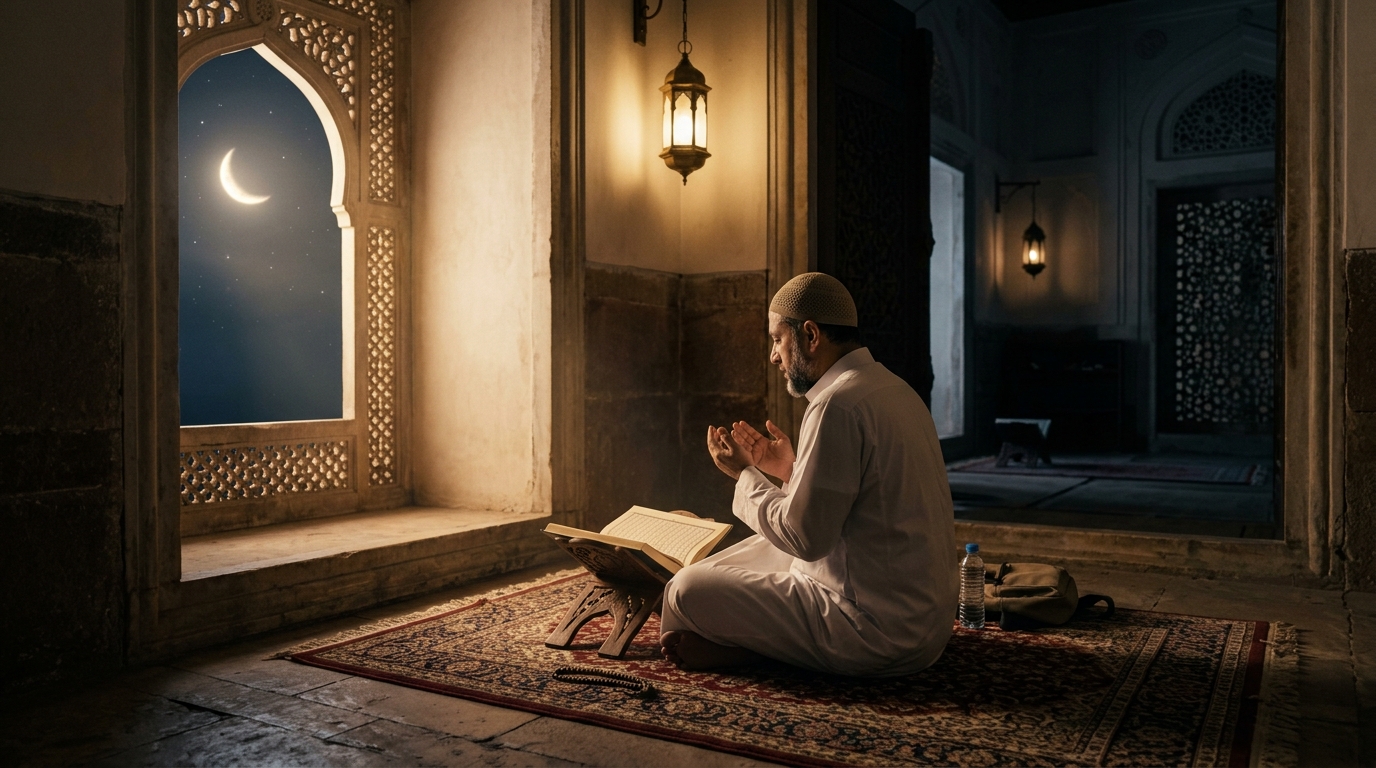
I'tikaf is an act of worship in which a Muslim dedicates time to remaining in a mosque for the purpose of worship, remembrance of Allah, prayer, Quran recitation, dua, and spiritual reflection.
It is particularly associated with the last ten days of Ramadan, when Muslims seek Laylat al-Qadr and increase their worship.
The Prophet Muhammad ﷺ regularly observed I'tikaf during the final ten days of Ramadan. Aisha رضي الله عنها reported that he continued this practice until his death, after which his wives also observed I'tikaf. Sahih al-Bukhari 2026; Sahih Muslim 1172a.
I'tikaf is not simply about staying inside a mosque. Its purpose is to temporarily reduce worldly distractions and dedicate more time to Allah.
What Does I'tikaf Mean?
The Arabic word I'tikaf (اعتكاف) (also spelled itikaf or i’tikaaf) carries the meaning of staying, remaining, or devoting oneself to something.
In Islamic practice, I'tikaf means remaining in the mosque with the intention of worship and devotion to Allah.
The Quran refers directly to I'tikaf in connection with mosques:
“Do not approach them while you are in I'tikaf in the mosques.” Quran 2:187
This verse establishes the connection between I'tikaf and remaining in the mosque.
The basic idea is simple:
Leave unnecessary worldly distractions → remain in the mosque → devote your time to worship and remembrance of Allah.
Why Do Muslims Perform I'tikaf?
The purpose of I'tikaf is not merely to spend several days inside a mosque.
It provides an opportunity to:
- Increase worship
- Spend more time in Salah
- Read and understand the Quran
- Make sincere dua
- Perform Dhikr
- Seek forgiveness
- Reflect on one's life
- Search for Laylat al-Qadr
- Reduce unnecessary worldly distractions
- Strengthen one's relationship with Allah
The final ten nights are particularly important because the Prophet ﷺ increased his worship during this period.
Aisha رضي الله عنها reported that when the final ten nights began, the Prophet ﷺ would stay awake at night, wake his family, and strive harder in worship. Sahih Muslim 1174.
Is I'tikaf Mentioned in the Quran?
Yes.
Allah says:
“Do not approach them while you are in I'tikaf in the mosques.” Quran 2:187
The verse occurs within the passage discussing Ramadan fasting and establishes that I'tikaf takes place in the mosques.
This is important because I'tikaf is sometimes described online as simply “isolating yourself at home.” While someone can dedicate time at home to worship and reflection, that is not the same as the established mosque-based I'tikaf described in the Quran and Sunnah.
Is I'tikaf Sunnah?
Yes. The Prophet ﷺ regularly observed I'tikaf during the last ten days of Ramadan.
Abdullah ibn Umar رضي الله عنهما reported:
The Messenger of Allah ﷺ used to observe I'tikaf during the last ten days of Ramadan. Sahih al-Bukhari 2025.
Aisha رضي الله عنها also reported that the Prophet ﷺ observed I'tikaf during the last ten days until his death. Sahih al-Bukhari 2026.
Therefore, I'tikaf is an established Sunnah and an important practice of the final part of Ramadan.
When Is I'tikaf Performed?
The most established practice is I'tikaf during the last ten days of Ramadan.
The final ten days begin with the night preceding Ramadan 21 and continue until Ramadan ends.
If Ramadan lasts:
- 29 days: the final ten days are Ramadan 20–29 by counting nights from the beginning of the night of 21.
- 30 days: they continue through Ramadan 30.
In practical terms, mosques commonly organize I'tikaf from around sunset on the 20th day of Ramadan, continuing until the end of Ramadan.
Because details concerning the exact start and end can differ between schools of Islamic jurisprudence, follow the arrangements and guidance of your mosque or qualified local scholar.
Why Is I'tikaf Especially Important in the Last Ten Days?
The final ten nights contain the opportunity to seek Laylat al-Qadr.
Allah says:
“The Night of Decree is better than a thousand months.” Quran 97:3
The Prophet ﷺ instructed Muslims to seek Laylat al-Qadr during the final ten nights.
Abu Sa'id al-Khudri رضي الله عنه reported that the Prophet ﷺ said:
“Look for it in the last ten nights and look for it in the odd ones.” Sahih al-Bukhari 2027.
I'tikaf therefore provides an environment where a person can devote much more time to worship during these important nights.
What Is the Best Way to Spend I'tikaf?
The best approach is not to fill every minute with a different activity.
Instead, establish a simple routine around the most important forms of worship.
Your priorities can be:
1. Salah
Protect the five obligatory prayers.
2. Quran
Read, understand, reflect upon, and study the Quran.
3. Night Prayer
Attend Taraweeh and perform additional Qiyam according to your ability.
4. Dua
Spend meaningful time asking Allah for forgiveness, guidance, mercy, and your personal needs.
5. Dhikr
Remember Allah regularly throughout the day.
6. Istighfar
Seek forgiveness sincerely and reflect on the changes you need to make.
7. Reflection
Use the quiet environment to evaluate your faith, habits, relationships, and goals.
8. Rest
Sleep sufficiently so that you can continue worship with concentration.
I'tikaf is about quality and sincerity, not simply accumulating hours awake.
What Should You Do During I'tikaf?
There is no requirement to follow a particular hourly schedule. You can organize your time around acts of worship.
Read the Quran
Make Quran recitation one of the central activities of your I'tikaf.
You can:
- Recite Arabic
- Read translation
- Read Tafsir
- Listen to recitation
- Memorize verses
- Reflect on meanings
- Write down lessons
- Think about how to apply the Quran after Ramadan
Don't turn Quran reading into a race.
Understanding even a smaller portion deeply can be highly beneficial.
Perform Salah
Your obligatory prayers should remain your first priority.
You can also perform voluntary prayers according to your ability, including:
- Sunnah prayers
- Taraweeh
- Tahajjud
- Qiyam al-Layl
- Other voluntary Salah
The Prophet ﷺ increased his night worship during the final ten nights. Sahih Muslim 1174.
Make Dua
Dua should have an important place in your I'tikaf.
Ask Allah for:
- Forgiveness
- Guidance
- Taqwa
- Strong faith
- Acceptance of your worship
- Protection from sin
- Goodness for your family
- Mercy for deceased relatives
- Halal provision
- Good health
- Success in the Hereafter
- Paradise
- Protection from Hellfire
Do not feel that you need hundreds of memorized duas.
A sincere conversation with Allah about your genuine needs can be deeply meaningful.
The Best Dua for Laylat al-Qadr
Aisha رضي الله عنها asked the Prophet ﷺ what she should say if she found Laylat al-Qadr.
He taught her:
اللَّهُمَّ إِنَّكَ عَفُوٌّ تُحِبُّ الْعَفْوَ فَاعْفُ عَنِّي
Transliteration:
Allahumma innaka 'afuwwun tuhibbul-'afwa fa'fu 'anni.
Meaning:
“O Allah, You are Most Forgiving, and You love to forgive, so forgive me.”
This is an authentic supplication reported in the hadith and is particularly appropriate for the final ten nights.
Increase Istighfar
I'tikaf is an excellent opportunity to examine your mistakes.
You can frequently say:
أَسْتَغْفِرُ اللَّهَ
Astaghfirullah
“I seek forgiveness from Allah.”
But don't allow Istighfar to become merely a repetition of words.
Think about:
- Which sins do I need to leave?
- Which habits are harming my faith?
- Whom have I wronged?
- What should I change after Ramadan?
- What kind of Muslim do I want to become?
Then make a sincere effort to change.
Make Dhikr
Use quiet periods for remembrance of Allah.
You can say:
- SubhanAllah
- Alhamdulillah
- Allahu Akbar
- La ilaha illallah
- Astaghfirullah
- Salawat upon the Prophet ﷺ
You can also spend time in quiet reflection rather than constantly trying to keep yourself occupied.
Can You Sleep During I'tikaf?
Yes.
Sleeping is not contrary to the purpose of I'tikaf.
In fact, adequate rest can help you maintain your worship throughout the final ten nights.
The mistake is to spend excessive time sleeping simply because you are inside the mosque.
A balanced routine might include:
Worship → rest → worship → prayer → Quran → rest
The objective is to worship Allah effectively, not to deprive yourself of all sleep.
Can You Eat During I'tikaf?
Yes.
You need to eat and drink during I'tikaf.
Meals should be kept reasonably simple so that food preparation does not become the main activity.
A good approach is:
- Eat enough to maintain energy
- Drink sufficient water
- Avoid excessive overeating
- Keep meals simple
- Avoid spending excessive time discussing food
Remember that I'tikaf is about reducing distractions.
Can You Talk During I'tikaf?
Yes, necessary and permissible conversation is not automatically forbidden.
However, unnecessary socializing can defeat the purpose of I'tikaf.
Try to reduce:
- Long conversations
- Jokes and entertainment
- Arguments
- Gossip
- Backbiting
- Unnecessary debates
- Constant phone conversations
Speak when there is a genuine need, but protect the peaceful atmosphere of worship.
Can You Use Your Phone During I'tikaf?
Using a phone is not automatically incompatible with I'tikaf.
You may need it for:
- Quran
- Islamic learning
- Reading reliable religious resources
- Family emergencies
- Necessary communication
- Work-related emergencies
But excessive phone use can seriously undermine the purpose of I'tikaf.
Try to avoid:
- Social media scrolling
- Short-video platforms
- Unnecessary messaging
- Gaming
- Entertainment
- Constant news checking
A useful rule is:
If the phone is taking more of your attention than your worship, it is time to put it away.
Can You Work During I'tikaf?
Ideally, I'tikaf involves stepping away from ordinary worldly activities as much as possible.
If your circumstances require limited communication or emergency responsibilities, deal with them appropriately.
However, don't turn I'tikaf into a normal working period inside the mosque.
If your job makes full I'tikaf impossible, you can still dedicate evenings or available periods to worship without claiming that this is the same as formal I'tikaf.
Can You Leave the Mosque During I'tikaf?
This is an important issue.
I'tikaf is based on remaining in the mosque, so unnecessary trips outside should be avoided.
There are established allowances for genuine needs, such as essential bodily needs that cannot be fulfilled inside the mosque.
The exact rulings concerning leaving the mosque vary according to circumstances and schools of Islamic jurisprudence.
Therefore, if you are planning a full I'tikaf, ask your mosque or qualified scholar beforehand about:
- Food arrangements
- Toilets and washing facilities
- Medical needs
- Work requirements
- Family emergencies
- Necessary travel
- Other unavoidable situations
What Breaks I'tikaf?
The detailed rulings can differ depending on the legal school and circumstances, but one fundamental principle is that I'tikaf requires remaining within the mosque for the intended worship.
Leaving the mosque without a valid reason can affect or terminate the I'tikaf according to the relevant ruling.
Sexual relations with one's spouse are explicitly prohibited during I'tikaf in Quran 2:187:
“And do not have relations with them while you are secluded for worship in the mosques.” Quran 2:187
Because questions about what invalidates I'tikaf can become quite detailed, anyone undertaking it should learn the specific rules according to the school of jurisprudence they follow.
Can You Leave the Mosque for a Family Emergency?
If a genuine emergency occurs, it should be dealt with according to the circumstances and Islamic ruling.
This is one reason it is wise to discuss your I'tikaf plans with your family before beginning.
Tell them:
- Where you will be
- How long you expect to remain
- How they can contact you in an emergency
- What situations genuinely require you to leave
The aim is to reduce unnecessary interruptions while still dealing responsibly with genuine needs.
I'tikaf and Family Responsibilities
I'tikaf should not be used as an excuse to ignore responsibilities that are genuinely yours.
Before entering I'tikaf, arrange matters such as:
- Childcare
- Household responsibilities
- Work arrangements
- Essential bills
- Family communication
- Medication
- Travel
- Food arrangements
Preparing these matters beforehand allows you to focus more fully on worship.
I'tikaf for Women
Women can also perform I'tikaf in the mosque when the necessary conditions and arrangements are met.
Aisha رضي الله عنها reported that the Prophet's wives observed I'tikaf after him. Sahih al-Bukhari 2026 and 2033.
This demonstrates that I'tikaf was not exclusively practised by men.
However, women should follow the arrangements and requirements of their mosque and qualified Islamic guidance.
Consider:
- A suitable and safe mosque environment
- Privacy
- Family responsibilities
- Personal needs
- Menstruation and related rulings
- Local mosque policies
There are differences among scholars regarding some detailed issues, so specific circumstances should be referred to a qualified scholar.
Can a Woman Perform I'tikaf at Home?
There are differences among Islamic scholars regarding women's I'tikaf at home and the detailed conditions surrounding it.
The Quran explicitly connects I'tikaf with mosques in 2:187, while the Prophet's wives performed I'tikaf in the mosque.
Therefore, if you are writing a general public article, it is better not to make a blanket statement that home I'tikaf is universally equivalent to mosque I'tikaf.
For a specific woman's circumstances, she should follow the guidance of a qualified scholar from the school of jurisprudence she follows.

What Should You Take to I'tikaf?
Keep your belongings practical.
Essential items
- Quran
- Islamic books
- Prayer clothes if needed
- Comfortable clothing
- Personal hygiene items
- Toothbrush/miswak
- Water bottle
- Medication if required
- Sleeping bag or bedding if the mosque permits it
- Small bag for personal belongings
- Phone and charger for necessary use
Avoid bringing unnecessary entertainment.
The less clutter you have, the easier it is to maintain focus.
I'tikaf Packing Checklist
| Item | Needed? |
|---|---|
| Quran | ✓ |
| Prayer clothing | If required |
| Comfortable clothing | ✓ |
| Toiletries | ✓ |
| Water bottle | ✓ |
| Medication | If required |
| Sleeping equipment | According to mosque rules |
| Phone | For necessary use |
| Charger/power bank | If permitted |
| Islamic books | Optional |
| Notebook | Useful |
| Entertainment devices | Best avoided |
Always check your mosque's own I'tikaf rules before bringing bedding, electrical devices, food, or other items.
A Good Daily I'tikaf Routine
There is no single mandatory timetable, but the following can provide structure.
| Time | Activity |
|---|---|
| Before Fajr | Tahajjud/Qiyam, Dua, Istighfar |
| Fajr | Salah + Quran |
| After Fajr | Quran, Dhikr, reflection |
| Morning | Rest if needed |
| Late Morning | Quran/Tafsir/Islamic study |
| Dhuhr | Salah + Quran |
| Afternoon | Dhikr, Dua, reading, rest |
| Asr | Salah + Quran |
| Before Maghrib | Dua + Istighfar |
| Maghrib | Iftar + Salah |
| Evening | Quran + family contact if necessary |
| Isha | Salah + Taraweeh |
| Late Night | Qiyam, Dua, Laylat al-Qadr supplication |
| Suhoor | Suhoor + Istighfar |
| Before Fajr | Personal Dua |
Don't become obsessed with following a timetable perfectly.
The routine should serve your worship, not become another source of stress.
How to Spend the Last Ten Nights During I'tikaf
A useful approach is to divide your attention into five areas.
Quran
Spend substantial time reading and reflecting.
Salah
Protect the obligatory prayers and perform additional night prayers.
Dua
Make sincere personal supplications.
Dhikr
Keep your tongue and heart connected to Allah.
Reflection
Think about how you will live after Ramadan.
This balance prevents I'tikaf from becoming nothing more than sitting in a mosque while spending hours on a phone.
I'tikaf and Laylat al-Qadr
The main spiritual opportunity of I'tikaf during Ramadan's final ten days is the search for Laylat al-Qadr.
Allah says:
“The Night of Decree is better than a thousand months.” Quran 97:3
The Prophet ﷺ encouraged Muslims to seek it during the final ten nights and especially the odd nights. Sahih al-Bukhari 2027.
The odd nights generally include:
- 21st night
- 23rd night
- 25th night
- 27th night
- 29th night
However, don't reduce Laylat al-Qadr to the 27th night alone.
The safer and more rewarding approach is to worship throughout the final ten nights.
Why Did the Prophet ﷺ Increase His Worship?
Aisha رضي الله عنها described the Prophet's practice during the final ten nights:
He would stay awake at night, wake his family, and strive harder in worship. Sahih Muslim 1174.
Another narration says:
“He used to exert himself in devotion during the last ten nights to a greater extent than at any other time.” Sahih Muslim 1175.
This gives Muslims a practical model:
The closer Ramadan comes to its end, the more seriously we should approach our worship.
What Should You Avoid During I'tikaf?
Avoid anything that unnecessarily defeats the purpose of spiritual retreat.
Avoid Excessive Talking
Keep conversations purposeful.
Avoid Social Media
Constant scrolling can consume hours of valuable worship time.
Avoid Gossip
Do not turn the mosque into a place for discussing other people's lives.
Avoid Arguments
Protect your peace and the peace of others.
Avoid Excessive Eating
Heavy meals can make night worship difficult.
Avoid Unnecessary Shopping
Plan your Eid shopping before I'tikaf where possible.
Avoid Entertainment
The purpose is spiritual retreat, not a change of location for leisure.
Avoid Showing Off
I'tikaf is an act of worship. Protect your sincerity.
Common I'tikaf Mistakes
Thinking I'tikaf Means Sleeping in the Mosque
Simply sleeping in a mosque does not capture the purpose of I'tikaf.
Spending Hours on Your Phone
Being physically inside the mosque while mentally absorbed in social media defeats much of the purpose of retreat.
Talking Constantly
The mosque can become a social gathering if people do not consciously protect their worship time.
Creating an Unrealistic Schedule
Trying to pray continuously with almost no sleep can lead to exhaustion.
Ignoring Other People
I'tikaf does not mean behaving badly toward fellow worshippers. Maintain cleanliness, quietness, and consideration.
Focusing Only on Quantity
Reading hundreds of pages without understanding anything is not necessarily better than reading less with reflection.
Searching Only for the 27th Night
Seek Laylat al-Qadr throughout the final ten nights.
How to Prepare for I'tikaf
Preparation should begin before Ramadan's final ten days.
1. Speak to Your Family
Make sure everyone understands your plans.
2. Speak to Your Mosque
Ask about:
- Registration
- Sleeping arrangements
- Food
- Shower facilities
- Security
- Opening and closing arrangements
- Women's facilities
- Mosque-specific rules
3. Complete Important Work
Finish unnecessary tasks before I'tikaf.
4. Prepare Your Essentials
Pack only what you actually need.
5. Prepare Your Worship Goals
Decide beforehand:
- Quran target
- Dua list
- Books to study
- Charity plans
- Night-prayer routine
6. Reduce Digital Distractions
Start reducing unnecessary social media use before I'tikaf begins.
I'tikaf and Intention
As with acts of worship generally, intention is important.
Before beginning I'tikaf, make a sincere intention to dedicate yourself to this worship for Allah.
The intention does not need to be complicated.
You are entering I'tikaf to worship Allah and seek His closeness and reward.
The exact wording of the intention does not need to become a ritual phrase that you repeat publicly.
What If You Cannot Complete the Full Ten Days?
Not everyone is able to dedicate the entire final ten days to I'tikaf.
People may have:
- Work
- Family responsibilities
- Health issues
- Travel
- Other legitimate circumstances
The detailed ruling on the minimum duration and conditions of I'tikaf varies according to Islamic jurisprudence.
Therefore, if you cannot commit to the full final ten days, ask a qualified scholar about what form of I'tikaf is valid according to the school you follow.
Regardless, you can still dedicate substantial time to worship during the final ten days.
Is I'tikaf Obligatory?
I'tikaf is not an obligation upon every Muslim during Ramadan.
It is an established Sunnah, particularly during the final ten days.
The Prophet ﷺ regularly observed it, and Aisha رضي الله عنها reported his continued practice. Sahih al-Bukhari 2026.
A Muslim who cannot perform I'tikaf should not think that they have failed Ramadan.
They can still worship through:
- Salah
- Quran
- Dua
- Dhikr
- Charity
- Fasting
- Night prayer
- Good deeds
The Spiritual Benefits of I'tikaf
Although the specific reward of an individual act should not be invented or exaggerated, I'tikaf offers a unique environment for worship.
It can help you:
Disconnect From Distractions
You temporarily step away from many ordinary routines.
Focus on Worship
Your surroundings naturally encourage Salah, Quran, and Dhikr.
Reflect
You have more time to think about your relationship with Allah.
Develop Discipline
You learn to control your time and attention.
Search for Laylat al-Qadr
You are in a better position to devote the final nights to worship.
Build Long-Term Habits
The habits developed during I'tikaf can continue after Ramadan.
I'tikaf: A Simple 10-Day Goal
Instead of trying to do everything, set a few realistic goals.
Quran Goal
Read a meaningful amount every day.
Prayer Goal
Attend all obligatory prayers and establish a consistent night-prayer routine.
Dua Goal
Make a personal dua list and revisit it throughout the final nights.
Character Goal
Choose one behaviour you genuinely want to improve.
Charity Goal
Give according to your means.
Post-Ramadan Goal
Choose two or three acts of worship that you will continue after Eid.
I'tikaf Checklist
Before entering I'tikaf:
- Check mosque arrangements
- Inform family
- Arrange work
- Arrange childcare if needed
- Prepare clothing
- Prepare Quran
- Pack toiletries
- Pack medication if needed
- Arrange sleeping equipment
- Prepare a dua list
- Reduce unnecessary phone use
- Set realistic worship goals
During I'tikaf:
- Pray five daily Salah
- Read Quran
- Perform Dhikr
- Make Dua
- Pray Taraweeh
- Pray Qiyam/Tahajjud
- Seek Laylat al-Qadr
- Give charity where possible
- Avoid gossip
- Avoid arguments
- Limit social media
- Rest sufficiently
- Maintain mosque cleanliness
I'tikaf vs Ordinary Mosque Stay
It is useful to understand the difference:
| I'tikaf | Ordinary Mosque Visit |
|---|---|
| Requires intention for I'tikaf | No I'tikaf intention |
| Dedicated period of worship | Usually shorter visit |
| Remain in the mosque | Enter and leave normally |
| Particularly associated with final ten days | Can happen throughout the year |
| Designed to reduce worldly distractions | Normal mosque activities |
| Strongly associated with Laylat al-Qadr | Not specifically connected to it |
Simply spending a few hours in the mosque does not automatically mean someone has completed the full traditional I'tikaf of the last ten days.
The Best Mindset for I'tikaf
Don't enter I'tikaf thinking:
“How many pages can I read?”
Instead think:
“How can these final days change my relationship with Allah?”
Don't focus only on how long you stay awake.
Focus on:
- Sincerity
- Concentration
- Repentance
- Quran
- Salah
- Dua
- Character
- Gratitude
- Long-term change
The goal is not merely to leave the mosque after ten days.
The goal is to leave Ramadan closer to Allah than when you entered it.
Final Words
I'tikaf is a special form of worship in which a Muslim dedicates time to remaining in the mosque for worship and remembrance of Allah. It is particularly associated with the final ten days of Ramadan and was a regular practice of the Prophet Muhammad ﷺ.
The Quran refers to I'tikaf in Surah Al-Baqarah 2:187, while authentic hadith demonstrate the Prophet's practice of observing it during the last ten days.
The best way to spend I'tikaf is not by filling every moment with activity, but by creating an environment where you can pray, read the Quran, make dua, perform Dhikr, seek forgiveness, pray at night, reflect, and search for Laylat al-Qadr.
The Prophet ﷺ increased his worship during the final ten nights, and authentic narrations show that he would stay awake in worship and encourage his family to do the same.
If you have the opportunity to perform I'tikaf, prepare properly, follow your mosque's rules, learn the relevant fiqh beforehand, and use those precious days to disconnect from unnecessary distractions and reconnect with Allah.
The real value of I'tikaf is not simply staying in the mosque—it is using that time to transform your worship, your heart, and your life.