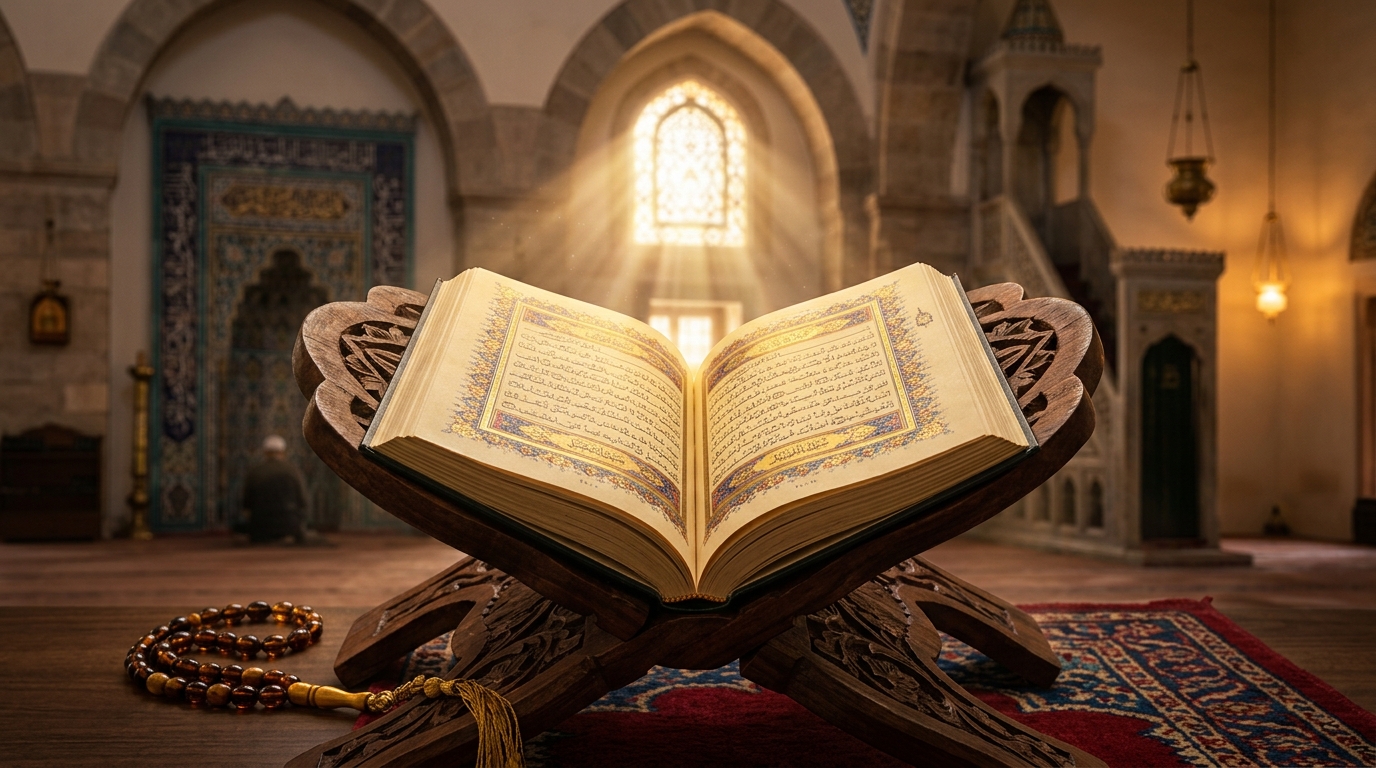
The Qur'an: The Heartbeat of Ramadan
Scholar Verified
Written by: M. Hamza
Researcher: Ayesha Rahman
Reviewed by: Omar Abdullah
Last Review: 9 September 2026
Our Ramadan information is carefully examined by a qualified Islamic reviewer to help ensure that religious details, references, and guidance are presented accurately and responsibly.
Muslims throughout the world, as they greet the holy month of Ramadan, greet not just a month of fasting but also the birthday of the most transformative event in the history of humanity: the very first revelation of the Qur'an. Ramadan and the Qur'an share a symbiotic relationship, and both are indivisible and existential in nature. To know Ramadan is to know the Qur'an, and to know the Qur'an is to know that it is the ultimate guide of human existence.
This article is all about the Qur'an, about how it was revealed during Ramadan and how divine it is and also how it is the ultimate guidance of humanity.
1. The Foundational Verse: When Revelation Met Time
The Qur'an itself declares its connection to Ramadan in a verse that every Muslim memorizes and cherishes:
"The month of Ramadan [is that] in which was revealed the Qur'an, a guidance for the people and clear proofs of guidance and criterion."
(Surah Al-Baqarah 2:185)
This single verse accomplishes three monumental things. First, it anchors the Qur'an to a specific time—Ramadan. Secondly, it explains that the Qur’an is not just a book, but it is actually hudan (guidance) meant for all of mankind. It is not only meant for Arabs and the seventh century. Thirdly, the Qur’an is referred to as "furqan" (distinguisher).
It did not come in one single blow. According to the classical exegetical tradition, the Qur’an came in two steps; firstly, the complete Qur’an came from the Preserved Tablet (Al-Lawh Al-Mahfuz) to the lowest heaven (Bayt al-Izza) on the night of Qadr in the month of Ramadan, then it was gradually revealed to Prophet Muhammad (peace be upon him) over a period of 23 years according to circumstances.
2. The Night That Outweighs a Lifetime – Laylat al-Qadr
If the Qur'an is the centerpiece of Ramadan, then Laylat al-Qadr is the hour when that centerpiece was gifted to the world. Allah dedicated an entire chapter of the Qur'an to this night:
"Indeed, We sent it [the Qur'an] down on the Night of Decree. And what can make you know what the Night of Decree is? The Night of Decree is better than a thousand months. The angels and the Spirit [Gabriel] descend therein by permission of their Lord for every matter. Peace it is until the emergence of dawn."
(Surah Al-Qadr 97:1-5)
For clarification purposes, just one night of worship during the month of Ramadan, should it fall on the night of Laylat al-Qadr, would exceed the worship of 83 years and four months (1,000 lunar months). This exceeds the lifespan of many people. The night of Laylat al-Qadr is concealed in the last ten odd days of Ramadan (21st, 23rd, 25th, 27th, and 29th) for the very reason that believers would make an effort in praying, reciting the Qur’an, and imploring Allah.
An incident that brings this to life:
The Prophet's wife, Aisha (may Allah be pleased with her), once asked him, "O Messenger of Allah, if I know which night is Laylat al-Qadr, what should I say?"
He taught her a concise, profound du'a:
"Allahumma innaka 'afuwwun tuhibbul 'afwa fa'fu 'anni"
(O Allah, indeed You are Pardoning and Generous; You love to pardon, so pardon me.)
(Sunan al-Tirmidhi)
The fact that the Prophet taught a prayer specifically for forgiveness on this night highlights the purpose of the Qur'an's revelation—to rescue humanity from sin and ignorance and guide them toward divine mercy.
3. The Qur'an's Self-Description—More Than Words on a Page
The Qur'an repeatedly defines itself in ways that emphasize its living, transformative power. It is not a book to be shelved; it is a force to be engaged with.
"And we send down of the Qur'an that is healing and mercy for the believers, but it does not increase the wrongdoers except in loss."
(Surah Al-Isra 17:82)
"Allah has sent down the best statement: a consistent book wherein there is repetition. The skins shiver therefrom of those who fear their Lord; then their skins and their hearts relax at the remembrance of Allah."
(Surah Az-Zumar 39:23)
These verses reveal three key attributes of the Qur'an relevant to Ramadan:
- It is healing (shifa). During Ramadan, Muslims seek physical and spiritual detoxification. The Qur'an cleanses the heart from jealousy, arrogance, and anxiety, replacing them with tranquility.
- It is mercy (rahmah). Every verse recited brings divine mercy upon the reciter, especially in this month when mercy is multiplied.
- It is consistent and profound. The Qur'an addresses the same core themes—Tawhid (oneness of God), prophethood, the afterlife, and righteous conduct—from multiple angles so that the reader is never left with ambiguity.
4. The Command to Recite, Reflect, and Implement
Ramadan is referred to historically as the month of the Qur’an. The most compelling example was given by the Prophet Muhammad (P.B.U.H.). Every night in the month of Ramadan, Angel Gabriel used to visit the Prophet to recapitulate the portions of the Qur'an that were revealed till then. In the last year of the life of the Prophet, Angel Gabriel recited the whole of the Qur'an twice.
A strong example that proves this:
The Holy Prophet (Allah’s peace be upon him) said, as reported by Ibn Abbas (Allah’s peace be upon him), that “he was the most generous amongst the people, and he used to become more generous than usual in the month of Ramadan, when Gabriel used to meet him." Gabriel used to meet him every night in the month of Ramadan.” (Bukhari, Muslim)
However, this kind of review was not a form of simple repetition. It was an exercise in teaching—re-examining rulings, clearing up ambiguities, and increasing comprehension. When the Prophet, to whom the message came directly, spent all his nights in Ramadan reviewing the Qur'an, how much more should others?
In modern times, thousands of Muslims recite the entire Qur'an within the 29 or 30 days of Ramadan, usually while reciting the Tarawih prayers at night. But the ultimate purpose is not the completion of the book but the act of tadabbur (reflecting). Allah says:
"Do they not then reflect on the Qur'an? Or are there locks upon their hearts?"
(Surah Muhammad 47:24)
"Then do they not reflect upon the Qur'an? If it had been from [any] other than Allah, they would have found within it much contradiction."
(Surah An-Nisa 4:82)
Thus, Ramadan is the ideal training ground to slow down, ponder a single verse for hours, and ask, "What is Allah telling me here? How does this change my behavior?"
5. The Profound Reward of Recitation—A Hadith That Inspires Action
The Qur'an is unique in that its recitation is an act of worship with measurable, multiplied rewards, especially in Ramadan. The Prophet (peace be upon him) said:
"Whoever recites a letter from the Book of Allah will receive a good deed, and the good deed is multiplied by ten. I do not say that 'Alif-Lam-Mim' is one letter, but rather 'Alif' is a letter, 'Lam' is a letter, and 'Mim' is a letter."
(Sunan al-Tirmidhi—authentic)
Given that Ramadan is the month in which good deeds are multiplied manifold, the reward for reciting the Qur'an during this sacred time reaches astronomical proportions. This is not meant to encourage mechanical, rapid recitation. Rather, it is an incentive to spend longer hours with the divine speech, ensuring that the tongue, the mind, and the heart are all engaged.
The early Muslims (Salaf) used to completely dedicate themselves to the Qur'an during Ramadan. It is reported that Imam Malik, the renowned scholar of Medina, would cease teaching Hadith during Ramadan and focus entirely on reciting the Qur'an from its pages. Similarly, many of the early believers would complete the Qur'an multiple times in a single month. Their goal was not speed but saturation—to let the words of Allah permeate every cell of their being.
6. The Qur'an as a Criterion for Action During Fasting
Fasting and the Qur'an work together like the two wings of a bird. Fasting empties the stomach, which helps purify the soul and sharpen the intellect for understanding revelation. The Qur'an, in turn, provides the moral framework for the fast. The Prophet said:
"Fasting is a shield. So when one of you is fasting, let him not speak obscenely nor act ignorantly. If someone fights him or insults him, let him say, 'I am fasting.'"
(Bukhari, Muslim)
This behavioral restraint is directly derived from the Qur'anic command:
"O you who have believed, decreed upon you is fasting as it was decreed upon those before you, that you may become righteous (muttaqun)."
(2:183)
Without the Qur'an, fasting would be mere starvation. With the Qur'an, fasting becomes a comprehensive moral training that curbs the tongue, the eyes, the ears, and the limbs from sin. The Qur'an teaches the fasting person to respond to provocation with patience—a lesson in emotional intelligence that can only be mastered through constant recitation and internalization of divine guidance.
7. A Renewed Relationship—Ramadan as the Annual Reset
The Qur'an was revealed in Ramadan to serve as humanity's permanent guide. However, human beings are forgetful. We drift, we become distracted, and we accumulate spiritual rust. Ramadan is the annual reset button—a month dedicated to re-establishing our bond with the Qur'an.
Allah says in the Qur'an:
"Those to whom We have given the Book recite it with its true recital. They [are the ones who] believe in it. And whoever disbelieves in it—it is they who are the losers."
(Surah Al-Baqarah 2:121)
The phrase "recite it with its true recital" (yatluwnahu haqqa tilawatihi) means to recite it properly, to reflect on its meanings, and to act upon its commands. Ramadan provides the perfect atmosphere—the quiet nights, the community prayers, the heightened spirituality—to achieve this true recital.
The early Muslims did not separate the Qur'an from life. When a verse about fasting was revealed, they fasted. When a verse about charity was revealed, they gave. When a verse about justice was revealed, they became just. Ramadan is the month to revive this holistic approach—to let every verse shape our choices, our purchases, our arguments, and our relationships.
The Qur'an Is the Gift; Ramadan Is the Season
To conclude, Ramadan without the Qur'an is like a body without a soul. The fast, the prayers, the charity, and the night vigils all derive their meaning and direction from the Qur'an. Allah himself summarized the purpose of this sacred month in the closing words of the foundational verse:
"So whoever among you witnesses the month, let him fast it... [Allah intends] for you to complete the period and to glorify Allah for that [to] which He has guided you; and perhaps you will be grateful." (2:185)
Gratitude for guidance—shukr—is the ultimate end of both Ramadan and the Qur'an. The Qur'an guides us to Allah, and Ramadan gives us the concentrated time to absorb that guidance fully. Every Ramadan, the Muslim community reenacts the historical moment when heaven touched earth—when the eternal speech of Allah was gifted to a mortal so that mortals could rise to their highest potential.
May this Ramadan be a turning point in each reader's relationship with the Qur'an—not merely as a text to be recited, but as a living, breathing companion that speaks to the heart, purifies the soul, and lights the path to eternal success.
Ramadan Calendar 360 — Your complete guide to Ramadan, Eid, and Islamic worship. Visit us for prayer times, Ramadan calendars, and more.