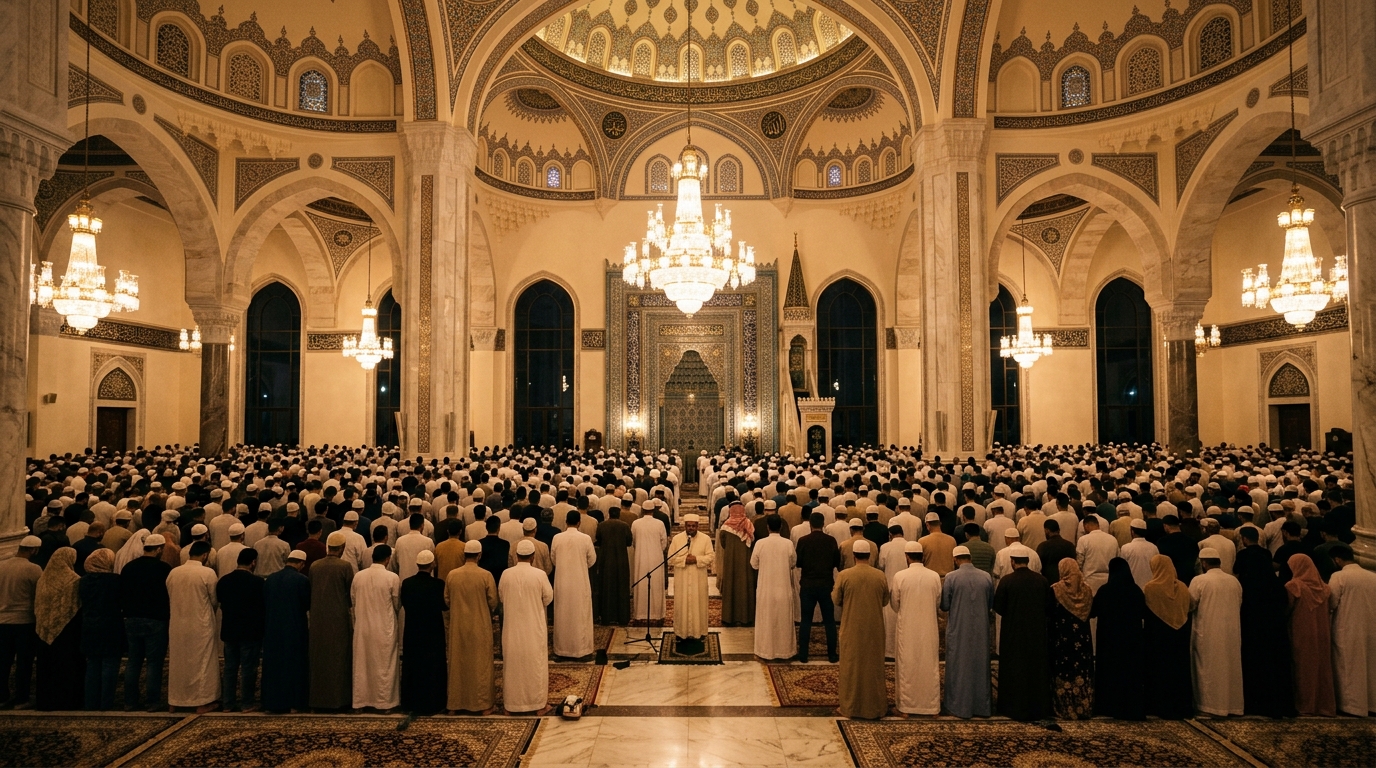
What Is Taraweeh?
Scholar Verified
Written by: M. Hamza
Researcher: Ayesha Rahman
Reviewed by: Omar Abdullah
Last Review: 9 September 2026
Our Ramadan information is carefully examined by a qualified Islamic reviewer to help ensure that religious details, references, and guidance are presented accurately and responsibly.
Taraweeh is a special voluntary prayer performed at night during Ramadan, after the Isha prayer. It is not obligatory, but it carries great reward. Muslims pray it individually or in congregation, usually at the mosque.
Hadith Evidence for Taraweeh
The Prophet Muhammad ﷺ said:
“Whoever stands in prayer during Ramadan out of faith and hoping for reward, his previous sins will be forgiven.”
Arabic: مَنْ قَامَ رَمَضَانَ إِيمَانًا وَاحْتِسَابًا غُفِرَ لَهُ مَا تَقَدَّمَ مِنْ ذَنْبِهِ
Transliteration: Man qāma Ramaḍāna īmānan waḥtisāban ghufira lahu mā taqaddama min dhanbih.
Translation: “Whoever prays during Ramadan with faith and hope for reward will have his previous sins forgiven.”
Sahih al-Bukhari
Is Taraweeh Obligatory?
No. Taraweeh is not an obligatory prayer.
It is a highly encouraged Sunnah prayer during Ramadan.
The five daily prayers remain obligatory for Muslims who are required to pray. Taraweeh is an additional act of worship that provides an opportunity to increase prayer and Qur'an recitation during the blessed month.
Meaning of the Word Taraweeh
Taraweeh comes from the Arabic word tarwihah, meaning "a period of rest." Early Muslims paused to rest briefly between sets of prayer. The name stuck, and it became the term for this Ramadan night prayer.
When Is Taraweeh Prayed?
Taraweeh is prayed after Isha, the last obligatory prayer of the day. It continues throughout the nights of Ramadan. Many mosques also combine it with reciting the entire Quran across the month, a portion each night.
Is Taraweeh Obligatory?
No. Taraweeh is Sunnah, not Fard. This means it isn't compulsory, but it is strongly recommended and highly rewarded. The Prophet ﷺ himself prayed it, though he later stopped praying it regularly in congregation, out of concern it might become seen as obligatory.
How Many Rak‘ahs Are in Taraweeh?
There is a recognised difference among scholars regarding the number of Taraweeh rak‘ahs.
- Some mosques pray eight rak‘ahs, followed by Witr.
- Many Hanafi, Maliki, and Shafi‘i communities pray twenty rak‘ahs, followed by Witr.
- Both practices have been accepted by respected scholars and Muslim communities.
The most important point is to pray with sincerity and avoid arguing over the number. Muslims should respect the practice of their local mosque.
Taraweeh is generally prayed to two rak‘ahs at a time. The Prophet ﷺ said:
“The night prayer is offered two by two.”
Arabic: صَلَاةُ اللَّيْلِ مَثْنَى مَثْنَى
Transliteration: Ṣalātu al-layli mathnā mathnā.
Translation: “The night prayer is offered two rak‘ahs at a time.”
Sahih al-Bukhari and Sahih Muslim
This is one of the most commonly asked questions, and scholars hold different views:
- 8 rakats – based on narrations describing how the Prophet ﷺ prayed at night in Ramadan, followed by Witr.
- 20 rakats – the practice established during the time of the second Caliph, Umar ibn al-Khattab, and followed by many Muslims today, particularly in the Hanafi and Shafi'i traditions.
Both views are considered valid within mainstream Islamic scholarship. The number of rakats is a matter of scholarly difference, not a point of major dispute.
Is Witr Part of Taraweeh?
Witr is a separate prayer, but it is usually offered after Taraweeh. It completes the night prayer.
The number of Witr rak‘ahs can differ between schools of thought. Many mosques pray three rak‘ahs of Witr after Taraweeh.
If you are praying at home, you can pray Taraweeh in sets of two rak‘ahs and then offer Witr at the end.
What Is the Best Time to Pray Taraweeh?
Taraweeh can be prayed after Isha during the night.
Praying earlier with the congregation is convenient for many Muslims. Others may prefer to pray later at night.
The best choice can depend on your circumstances and ability to maintain concentration and consistency in worship.
Can Women Pray Taraweeh?
Yes. Women can pray Taraweeh at the mosque or at home. Praying at home is also acceptable and, for many scholars, considered equally rewarding.
Can Taraweeh Be Prayed at Home?
Yes. Taraweeh does not have to be performed in a mosque. A person can pray alone or with family members at home.
If you are tired, unwell, travelling, or unable to reach the mosque, praying at home is a good option. Even a short prayer offered sincerely is valuable.
Quranic Connection to Night Prayer in Ramadan
Arabic:
إِنَّ نَاشِئَةَ اللَّيْلِ هِيَ أَشَدُّ وَطْئًا وَأَقْوَمُ قِيلًا
Transliteration:
Inna nashi'ata al-layli hiya ashaddu wat'an wa aqwamu qeela.
Translation:
"Indeed, rising by night is more effective for concentration and more suitable for [understanding] speech." (Surah Al-Muzzammil, 73:6)
This verse highlights the general virtue of night prayer, which Taraweeh reflects during Ramadan specifically.
Is Taraweeh Different From Qiyam al-Layl?
Qiyam al-Layl means standing in prayer at night and is a broader term.
Taraweeh is the name commonly used for the Ramadan night prayer.
Therefore, Taraweeh can be understood as a form of Qiyam al-Layl performed during Ramadan.
What If I Cannot Complete All the Rak‘ahs?
You can pray as much as you are able. It is better to pray a smaller number consistently than to pray a long prayer once and then stop completely.
You may leave after completing your own prayer. However, staying with the imam until he finishes brings a special reward.
The Prophet ﷺ said:
“Whoever prays with the imam until he finishes, it will be recorded for him as if he spent the whole night in prayer.”
Transliteration: Man qāma ma‘a al-imāmi ḥattā yanṣarifa kutiba lahu qiyāmu laylah.
Translation: “Whoever stands in prayer with the imam until he finishes will receive the reward of spending the whole night in prayer.”
Jami‘ al-Tirmidhi
Taraweeh and the Quran
Taraweeh is closely connected with the Quran. During the prayer, the imam may recite several pages each night.
Many mosques aim to complete the Quran by the end of Ramadan. However, completing the entire Quran is not a condition for Taraweeh. A person can pray Taraweeh even when shorter surahs are recited.
Try to listen carefully and reflect on the meaning of the verses. The purpose is not only to finish a recitation. It is also to improve faith and understanding.
Key Facts About Taraweeh at a Glance
| Question | Answer |
|---|---|
| Prayer type | Sunnah (voluntary), not obligatory |
| Time | After Isha, throughout Ramadan |
| Common rakat counts | 8 or 20, both valid |
| Can be prayed at home? | Yes |
| Can women pray for it? | Yes |
Simple Tips for Taraweeh
- Pray Isha before joining Taraweeh.
- Arrive early if you are praying at the mosque.
- Bring a Quran translation if it helps you understand the recitation.
- Avoid heavy meals before prayer.
- Drink enough water between Iftar and Suhoor.
- Pray at a comfortable pace.
- Stay for Witr if possible.
- Do not miss the Fajr prayer because of late nights.
- If you cannot attend the mosque, pray at home.
At Ramadan Calendar 360, our aim is to provide clear and useful Ramadan information for Muslims around the world, while respecting legitimate differences in Islamic scholarship.
Frequently Asked Questions
No. Isha is a separate, obligatory prayer prayed first. Taraweeh is an additional, voluntary prayer prayed after it.
Nothing is owed or required to be made up. Since it's voluntary, missing a night carries no sin, though continuing regularly brings more reward.
No, scholars differ, mainly between 8 and 20 rakats. This is an accepted area of scholarly difference, not a core disagreement.
Ramadan Calendar 360 — Your complete guide to Ramadan, Eid, and Islamic worship. Visit us at Ramadan Calendar 360 for prayer times, Ramadan calendars, and more.