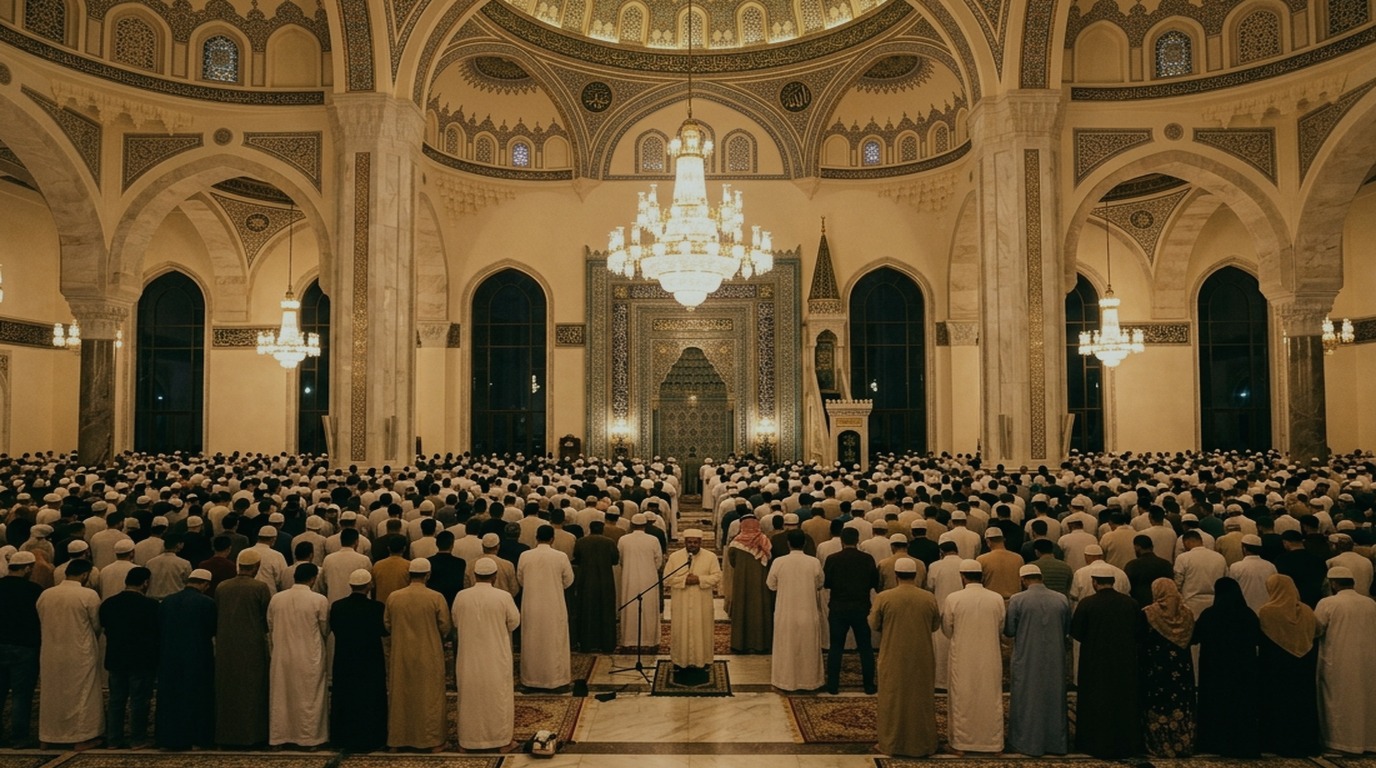
How to Pray Taraweeh: Complete Guide
Scholar Verified
Written by: M. Hamza
Researcher: Ayesha Rahman
Reviewed by: Omar Abdullah
Last Review: 9 September 2026
Our Ramadan information is carefully examined by a qualified Islamic reviewer to help ensure that religious details, references, and guidance are presented accurately and responsibly.
Taraweeh prayer involves performing the prayer in twos (raka'ahs, like normal Sunnah prayers) after the night prayer of Isha, during the month of Ramadan. People usually pray 8 raka'ahs or 20 raka'ahs, followed by Witr. Each of the twos consists of an exact pattern that is used in any two-rakat prayer.
Step 1: Pray Isha First
The taraweeh prayer always follows the fard prayer of Isha, and never precedes it. Make sure that you complete your Isha and Sunnah (if you make sunnah) prayers first before going for the taraweeh prayer.
Step 2: Make Your Intention (Niyyah)
The niyyah does not have to be verbally said. The niyyah could simply be in your heart. Niyyah means that you intend to pray taraweeh for the sake of Allah.
Step 3: Pray in Sets of Two Rakats
Taraweeh is prayed two rakats at a time, with a Salam (ending greeting) after each pair, exactly like a normal two-rakat Sunnah prayer.
Each pair follows this structure:
- 1.Say "Allahu Akbar" to begin.
- 2.Recite Surah Al-Fatiha, followed by another surah or verses of your choice.
- 3.Bow (Ruku), then stand up straight.
- 4.Prostrate (Sujood) twice, with a short sitting in between.
- 5.Stand for the second rakat and repeat steps 2–4.
- 6.Sit for the final tashahhud, then give Salam to end the pair.
Repeat this pattern for as many pairs as you're praying that night.
Step 4: Take a Short Rest Between Sets (Optional)
Traditionally, there used to be a short break taken between each four rakats, which has led to naming this prayer "Taraweeh" ("rest"), because it is an informal practice and only implies resting.
Step 5: Decide How Many Rakats to Pray
- 8 rakats – based on how the Prophet ﷺ prayed at night in Ramadan.
- 20 rakats – the practice widely followed since the time of Umar ibn al-Khattab.
Both are valid. Many mosques follow 20 rakats; praying 8 at home is also perfectly acceptable.
Step 6: Finish With Witr
Taraweeh prayer ends with the Witr prayer, which is usually performed during one or three rakats, because Witr is an odd-numbered prayer that marks the end of the day's prayer.
Praying Taraweeh in Congregation vs. Alone
Arabic: صَلَاةُ الْجَمَاعَةِ أَفْضَلُ مِنْ صَلَاةِ الْفَذِّ بِسَبْعٍ وَعِشْرِينَ دَرَجَةً
Transliteration: Salatul jama'ati afdalu min salatil fadhdhi bi sab'in wa 'ishrina darajah.
Translation: "Prayer in congregation is twenty-seven times more rewarding than prayer performed individually." (Sahih al-Bukhari, Sahih Muslim)
This is why many people choose to pray Taraweeh at the mosque, though praying alone at home remains valid, especially when attending isn't possible.
Following the Imam in Congregation
If praying behind an imam, simply follow his movements, standing, bowing, and prostrating with him, and say your Salam when he does. There's no need to count rakats yourself; the imam leads the full set.
Common Mistakes to Avoid
- Rushing through the recitation. Taraweeh is meant to be reflective, not fast-paced.
- Skipping the Witr prayer. It's a core part of completing the night's prayer, not optional filler.
- Assuming a fixed rakat count is required. Both 8 and 20 are accepted; there's no single "correct" number.
- Praying it before Isha. Taraweeh always follows Isha, never precedes it.
Quick Reference: Taraweeh Structure
| 1 | Pray Isha first |
| 2 | Make intention |
| 3 | Pray 2 rakats at a time, with Salam after each pair |
| 4 | Optional short rest every 4 rakats |
| 5 | Repeat until 8 or 20 rakats complete |
| 6 | Pray Witr to finish |
Ramadan Calendar 360 — Your complete guide to Ramadan, Eid, and Islamic worship. Visit us at Ramadan Calendar 360 for prayer times, Ramadan calendars, and more.